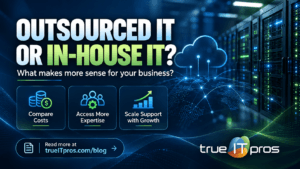
MSP vs Internal IT Team: Which Is Right for You?
The MSP vs internal IT team decision is really a business decision. It affects cost, employee support, security, response time, and how well your company can grow without IT becoming a daily obstacle.
For a growing business in Atlanta, the right answer depends on your size, tools, risk level, hours of operation, and how much support your employees need. A real estate firm, accounting office, veterinary practice, construction company, or financial services team may all need different levels of IT coverage.
This managed IT provider comparison will help you understand when an internal hire makes sense, when an MSP makes sense, and when a blended model may be the best fit.
An MSP is often the better fit when your business needs broader IT coverage, predictable support, proactive monitoring, and access to multiple technical skills without hiring a full internal team.
What Is the Difference Between an MSP and an Internal IT Team?
An internal IT team is made of employees who work directly for your company. An MSP, or managed service provider, is an outside IT partner that supports your business through ongoing monitoring, helpdesk support, security maintenance, cloud administration, and technology planning.
With an internal IT employee, your company owns the role, salary, benefits, training, coverage gaps, and workload limits. With an MSP, your company works with a team that can provide a wider range of skills across support, infrastructure, networking, cloud tools, device management, and security.
For many Atlanta small and mid-sized businesses, managed IT can be a practical way to gain stronger support without building a full in-house department too early.
MSP vs Internal IT Team: Quick Comparison
The best choice depends on what your business needs most. Some companies need daily onsite help. Others need better monitoring, faster response, stronger security, and access to more technical experience.
| Factor | Internal IT Team | MSP |
|---|---|---|
| Cost | Salary, benefits, tools, training, and coverage costs | Predictable monthly service cost based on scope |
| Coverage | Limited by staff size, hours, vacations, and workload | Team-based support, monitoring, and escalation options |
| Expertise | Depends on the person or small team you hire | Access to helpdesk, network, cloud, security, and planning skills |
| Response Time | Can be fast if the person is available and not overloaded | Structured support through web chat, email, or phone |
| Scalability | May require new hires as the business grows | Can scale support as users, devices, locations, and systems grow |
When Does an Internal IT Team Make Sense?
An internal IT team can make sense when your business has enough daily IT work to justify full-time staff. This is more common when the company has many users, complex systems, custom applications, or a need for constant onsite support.
An internal IT employee may be a good fit when your company needs someone who deeply understands your internal processes and is available for hands-on work each day.
An internal IT team may fit your business if:
- You have a large number of employees in one office.
- Your systems require constant onsite attention.
- You have custom software that needs daily internal support.
- You can afford salary, benefits, tools, training, and backup coverage.
- You already have leadership that can manage IT strategy and risk.
The challenge is that one person cannot be an expert in everything. A single internal IT employee may be asked to handle helpdesk tickets, Microsoft 365, Google Workspace, networking, phones, security tools, backups, software updates, vendors, and long-term planning. That can create overload fast.
When Does an MSP Make More Sense?
An MSP usually makes more sense when a business needs reliable IT support but is not ready to hire a full internal IT department. It can also help when an existing internal IT person needs backup, monitoring, security support, or project help.
For example, an Atlanta law firm may need fast user support, secure file access, email protection, and dependable systems during client deadlines. A veterinary practice may need stable workstations, scheduling software, payment systems, and secure records access. A construction company may need support for office staff, field users, mobile devices, and cloud tools.
An MSP may fit your business if:
- Your team is growing and IT issues are slowing people down.
- You want predictable monthly IT support costs.
- You need support across devices, users, cloud tools, and networks.
- Your internal staff cannot keep up with tickets and projects.
- You want better monitoring, maintenance, and planning.
- You need cybersecurity support but do not have security staff in-house.
The right MSP should not only fix problems. It should help your business prevent avoidable issues, support users faster, and plan technology around business needs.
How Should You Compare IT Support Costs?
To compare cost fairly, look beyond the monthly invoice or salary. Internal IT costs include recruiting, salary, benefits, training, software tools, coverage during time off, and the risk of one person being stretched too thin.
MSP costs are usually easier to plan because they are tied to a defined service scope. For many growing businesses, this can make budgeting simpler than hiring multiple roles before the company is ready.
Cost questions to ask before deciding
- How many users need support?
- How many laptops, desktops, servers, and mobile devices need management?
- Do employees need help outside normal office hours?
- How much downtime can the business tolerate?
- Who manages software updates, patches, backups, and cloud tools?
- Who handles vendor issues when internet, phones, printers, or business apps fail?
A lower-cost option is not always the better business choice. If a cheaper model leads to slow response, repeated problems, or no proactive maintenance, the business may pay for it through lost time and frustrated employees.
Which Option Gives Better IT Coverage?
An MSP often gives broader coverage because support is not limited to one employee. A managed provider can assign different people to helpdesk support, networking, cloud administration, security maintenance, and technology planning.
This matters when your business has multiple needs happening at the same time. One person may be troubleshooting a printer issue while another employee cannot access email, a manager needs a new user set up, and a vendor needs help with a line-of-business application.
trueITpros supports Atlanta businesses with services such as endpoint management, software updates and security patch maintenance, antivirus and malware protection, Office 365 and G-Suite administration, managed networking, phone system support, business continuity service, and IT infrastructure monitoring by a NOC.
How Do Response Time and Helpdesk Support Compare?
Response time depends on structure, not just good intentions. An internal IT employee may respond quickly when available, but response slows down when that person is busy, out of office, or working on a larger issue.
An MSP can provide a more formal support path. That may include ticket intake, web chat, email, phone support, escalation, monitoring alerts, and documented processes.
For a growing Atlanta business, this can reduce confusion. Employees know where to ask for help. Managers know issues are tracked. The business can see patterns instead of dealing with the same problem again and again.
What About Expertise and Security?
An MSP can give a growing business access to more types of technical expertise. This is useful when your needs go beyond basic desktop support.
For example, your company may need help with Microsoft 365, Google Workspace, DNS protection, endpoint security, cloud access, user permissions, backups, network reliability, vendor management, and IT policies. That is a lot for one internal generalist to handle alone.
Cybersecurity should also be part of the comparison. Managed IT does not remove every risk, but it can help reduce avoidable gaps by keeping devices updated, supporting users, managing access, monitoring systems, and responding when something looks wrong.
Business owners can also review practical guidance from trusted public resources such as the Cybersecurity and Infrastructure Security Agency and the Federal Trade Commission small business cybersecurity guidance.
Can You Use Both an MSP and Internal IT?
Yes. Many businesses use a co-managed IT model. In this setup, an internal IT employee handles company-specific needs while the MSP provides backup, monitoring, helpdesk overflow, security maintenance, projects, or strategic planning.
This can be a strong option for businesses with growing teams. The internal person keeps local knowledge, while the MSP adds depth and coverage.
A co-managed model can help when:
- Your internal IT person is overloaded.
- You need better monitoring and after-hours alerting.
- You need help with projects like cloud migrations or network upgrades.
- You want stronger documentation and IT policies.
- You need a Virtual CIO or CTO perspective for planning.
How Should an Atlanta Business Make the Decision?
Start by matching the IT model to your business risk and growth stage. A five-person office has different needs than a 60-person professional services firm with remote staff, client data, cloud applications, and multiple locations.
Use this simple decision framework before choosing between an MSP and an internal IT team.
- List your daily support needs. Include computers, phones, email, cloud tools, printers, applications, and user access.
- Identify your risk areas. Look at email security, backups, device updates, remote access, vendor dependencies, and business continuity.
- Review your response expectations. Decide how quickly employees need help and whether support is needed outside normal hours.
- Compare total cost. Include salary, benefits, tools, training, vendor costs, and the cost of slow response.
- Plan for growth. Consider how IT needs will change as you add employees, locations, software, and compliance expectations.
Common Mistakes Businesses Make During This Comparison
The most common mistake is comparing only the visible cost. IT support should also be measured by coverage, skill depth, security maintenance, response process, documentation, and long-term planning.
Watch for these mistakes:
- Hiring one internal person and expecting them to cover every IT need.
- Choosing an MSP without asking about response process and escalation.
- Ignoring security maintenance until there is a serious issue.
- Not documenting systems, vendors, licenses, and user access.
- Waiting until growth creates daily IT frustration.
A better approach is to review your IT environment before problems become routine. That includes devices, users, cloud tools, network equipment, backups, security tools, vendors, and business applications.
What Should You Look for in a Managed IT Provider?
A managed IT provider should be clear about services, support channels, response expectations, billing, contracts, and how they help your business plan ahead. The provider should also explain technical work in plain English.
For Atlanta businesses, local context also matters. A provider that understands small business operations can better support professional firms, offices, field teams, and industry-specific tools.
Questions to ask an MSP before signing
- What services are included in the monthly plan?
- How do employees request support?
- What is the helpdesk response process?
- Do you support Microsoft 365, Google Workspace, business apps, phones, and networking?
- How do you handle software updates and security patches?
- Do you provide onsite support when needed?
- Do you offer Virtual CIO or CTO guidance?
- Are there annual contracts or month-to-month options?
trueITpros offers practical managed IT services for Atlanta businesses, including helpdesk support, onsite support, endpoint management, managed networking, business continuity service, customer success management, Virtual CIO and CTO services, monthly payments, consolidated billing, and no annual contracts.
FAQ: MSP vs Internal IT Team
Is an MSP cheaper than hiring internal IT?
An MSP may be more cost-effective for businesses that need broad IT support but are not ready to hire a full internal team. The right comparison should include salary, benefits, tools, training, coverage, and response needs.
Can an MSP replace an internal IT employee?
In many small and mid-sized businesses, an MSP can handle most day-to-day IT support and maintenance. In larger companies, an MSP may work alongside internal IT as a co-managed partner.
When should a growing business consider an MSP?
A business should consider an MSP when IT issues become frequent, employees wait too long for help, security updates are inconsistent, or growth makes technology harder to manage.
Do MSPs provide cybersecurity support?
Many MSPs provide cybersecurity-related services such as patching, antivirus protection, DNS protection, monitoring, access support, and breach response support. The exact level depends on the provider and service plan.
What should Atlanta businesses look for in an MSP?
Atlanta businesses should look for clear support channels, proactive maintenance, local business understanding, security awareness, scalable services, transparent billing, and practical technology planning.
Choose the IT Model That Supports Your Growth
The right choice is not always MSP or internal IT. It is the model that helps your business stay supported, secure, productive, and ready for growth.
If your company needs daily onsite control, an internal IT employee may make sense. If you need broader coverage, predictable support, stronger monitoring, and access to more technical skills, an MSP may be the better fit. If you already have internal IT but need more depth, a co-managed model can help.
To learn more about how trueITpros can help your company with Managed IT Services in Atlanta, contact us at www.trueitpros.com/contact