In-House IT vs Outsourced IT: SMB Guide
The choice between in house IT vs outsourced IT can shape how your small business handles support, security, downtime, and technology planning.
For many growing Atlanta businesses, the question is not just who fixes the computers. It is who keeps employees working, protects systems, manages vendors, supports cloud tools, and helps the business make better technology decisions.
Both models can work. The right choice depends on your size, risk level, budget, internal workload, and how much technical coverage your team needs each week.
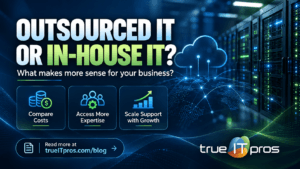
In-house IT gives your business direct internal control. Outsourced IT gives your business access to a broader support team, proactive monitoring, and predictable service without hiring a full internal department.
What is in-house IT?
In-house IT means your business hires one or more employees to manage technology internally.
This person may handle helpdesk requests, computer setup, software issues, network problems, vendor communication, security tools, backups, and long-term planning. In a small business, one IT employee often wears many hats.
This model can be useful when your company has very specific systems, a large user base, or a daily need for on-site technical support.
Common in-house IT responsibilities
- Employee computer setup and troubleshooting
- Software installation and updates
- Network and Wi-Fi support
- User account management
- Printer, phone, and device support
- IT vendor coordination
- Basic security management
- Backup and recovery oversight
What is outsourced IT support?
Outsourced IT support means your business works with an external IT provider to manage, support, monitor, and protect your technology environment.
For a small business, outsourced IT can include helpdesk support, endpoint management, software patching, cloud administration, managed networking, security monitoring, business continuity services, and strategic IT guidance.
An outsourced provider can also support internal teams. Some businesses use outsourced IT as their full IT department. Others use it to support an internal employee who needs extra coverage, tools, or expertise.
For Atlanta companies that need a more structured support model, managed IT can help move IT from reactive fixes to proactive support.
In-house IT vs outsourced IT: the main differences
The main difference is structure. In-house IT depends on employees inside your company. Outsourced IT depends on an external team with shared tools, processes, and support coverage.
| Category | In-House IT | Outsourced IT |
|---|---|---|
| Control | Direct internal oversight | Shared responsibility with an external provider |
| Cost structure | Salary, benefits, tools, training, and coverage gaps | Usually a recurring monthly service cost |
| Coverage | Limited by staff size and availability | Access to a broader support team and monitoring tools |
| Expertise | Depends on the skills of the person hired | Can include helpdesk, networking, cloud, security, and strategy |
| Scalability | Requires hiring as the business grows | Can scale support as needs change |
When does in-house IT make sense?
In-house IT can make sense when a business needs daily on-site technical work, has complex internal systems, or wants a dedicated employee focused only on its environment.
For example, a manufacturing company with production systems, warehouse devices, office users, and plant-floor technology may benefit from having someone on site who understands the physical environment.
In-house IT may be a good fit if:
- Your business has enough IT work for a full-time employee
- You need frequent hands-on support at one location
- Your systems are highly customized
- You have the budget for salary, benefits, tools, and training
- You can manage coverage when that employee is out
When does outsourced IT support make sense?
Outsourced IT support makes sense when a small business needs reliable technology support but is not ready to build a full internal IT department.
This is common for law firms, accounting firms, real estate teams, insurance agencies, nonprofits, construction companies, and professional service businesses in Atlanta. These companies rely on email, cloud tools, files, phones, payment systems, and secure access, but they may not have enough internal IT work to justify multiple full-time hires.
Outsourced IT may be a good fit if:
- Your employees need faster helpdesk support
- Your current IT setup is too reactive
- Your business needs better device and software management
- You want predictable monthly IT costs
- You need support for Microsoft 365, Google Workspace, phones, networks, and business applications
- You want IT planning without hiring a full-time CIO or CTO
What costs should SMBs compare?
Small businesses should compare the full cost of each model, not just salary or monthly service fees.
An internal hire may seem simple at first, but the total cost can include recruiting, benefits, ongoing training, software tools, security tools, monitoring tools, backup systems, coverage gaps, and management time.
Outsourced IT usually works as a monthly service model. That can help small businesses plan around more predictable IT spending, especially when the provider includes helpdesk support, monitoring, management, and strategic guidance.
Cost areas to review
- Employee salary and benefits
- IT tools and licenses
- Security software and monitoring
- Backup and business continuity tools
- Training and certifications
- After-hours or emergency coverage
- Time lost when support is unavailable
- Vendor management and project support
Why one internal IT person may not be enough
One IT employee can be valuable, but one person cannot always cover every technical need a growing business faces.
A small business may need helpdesk support, networking, cloud administration, email security, endpoint protection, backups, vendor management, phone support, and long-term planning. Those are different skill areas.
The risk is not that the employee is unqualified. The risk is that too much depends on one person. If they are busy, out sick, on vacation, or focused on a project, daily support can slow down.
The question is not whether one IT person can help. The question is whether one person can support users, manage risk, maintain systems, handle projects, and plan ahead without creating bottlenecks.
How outsourced IT support helps Atlanta SMBs stay proactive
Outsourced IT support helps small businesses move away from waiting for problems and toward ongoing monitoring, maintenance, and planning.
For example, an Atlanta accounting firm cannot afford to have employees locked out of files during a busy deadline week. A real estate firm may need secure access from the office, home, and the field. A law practice may need reliable email, document access, and user support throughout the day.
In each case, the business needs more than basic troubleshooting. It needs a support structure that keeps systems managed before problems disrupt work.
Proactive outsourced IT can include:
- Endpoint management for laptops, desktops, and workstations
- Software updates and security patch maintenance
- Antivirus and malware protection
- Web surfing DNS protection
- Office 365 and G-Suite administration
- Line of business app technical support
- Managed networking
- Business continuity service
- 24/7 IT infrastructure monitoring by NOC
- Phone system support
- Virtual CIO and CTO services
What about cybersecurity?
Cybersecurity should be part of the IT support conversation, whether your business chooses in-house IT, outsourced IT, or a hybrid model.
Small businesses often depend on email, shared documents, cloud applications, payment tools, and remote access. A weak password process, unmanaged device, missed software patch, or compromised mailbox can affect daily operations and client trust.
Outsourced IT can help reduce avoidable security gaps by adding structure around updates, endpoint protection, account administration, monitoring, and response. The right approach depends on your users, systems, tools, and risk profile.
Can a business use both in-house and outsourced IT?
Yes. Many growing businesses use a hybrid IT model.
In this model, an internal employee handles company-specific needs, while an outsourced IT provider helps with monitoring, helpdesk overflow, cybersecurity support, vendor management, projects, and strategic planning.
This can work well when the business likes having internal ownership but needs more depth, coverage, or specialized support than one person can provide.
A hybrid model may help when:
- Your internal IT person is overloaded
- Your company needs better after-hours or backup coverage
- You have projects that need extra technical support
- Your business needs more cybersecurity structure
- Leadership wants strategic IT planning without hiring an executive-level IT role
How should a small business choose?
A small business should choose the IT model that gives it enough support, enough coverage, and enough planning without creating unnecessary cost or risk.
The best way to compare in-house IT vs outsourced IT is to look at daily support needs, security exposure, business growth, downtime tolerance, cloud tools, and leadership expectations.
Use this decision checklist
- How many employees need IT support each week?
- How quickly do support issues need to be resolved?
- Do you need on-site support often, or only sometimes?
- Who manages updates, patches, and endpoint protection?
- Who supports Microsoft 365, Google Workspace, and user accounts?
- Who monitors your network and infrastructure?
- What happens when your current IT person is unavailable?
- Do you have a tested backup and business continuity plan?
- Do you need IT planning for growth, compliance, or security expectations?
- Would predictable monthly IT costs help your business plan better?
What should Atlanta SMBs expect from outsourced IT support?
Atlanta SMBs should expect outsourced IT support to be practical, responsive, security-conscious, and aligned with how the business actually works.
A good IT partner should not only fix issues when employees complain. The provider should help manage systems, reduce recurring problems, document the environment, support users, monitor infrastructure, and guide technology decisions.
Look for an IT provider that offers:
- Clear helpdesk support options by web chat, email, or phone
- Fast response expectations, such as a 10 minute helpdesk response SLA
- Availability from 6AM to 6PM EST, Monday through Friday
- 24 hours, 7 days a week availability when applicable
- Onsite support for infrastructure and end users when needed
- Monthly payments and consolidated billing
- No annual contracts
- A Customer Success Manager
- Virtual CIO and CTO services for planning
When should you contact an outsourced IT provider?
You should contact an outsourced IT provider when IT issues are slowing people down, support is inconsistent, security feels unclear, or leadership does not have a clear technology plan.
You do not need to wait for a major outage. It is often better to review your IT setup before small problems become daily interruptions.
Warning signs to watch for
- Employees complain about slow support
- The same IT problems keep returning
- Software updates are not managed consistently
- No one is sure if backups are working
- Cloud account access is messy or undocumented
- The business has no clear plan for device replacement
- Security tools are installed but not actively managed
- Your internal IT person is too busy to plan ahead
FAQ: In-house IT vs outsourced IT
Is outsourced IT better than in-house IT?
Outsourced IT is not automatically better. It is often a better fit when a small business needs broader support, monitoring, security structure, and predictable costs without building a full internal IT department.
How much IT support does a small business need?
The right level depends on your users, devices, systems, risk level, and downtime tolerance. A small office with basic tools may need light support, while a growing firm with remote users and sensitive files may need more proactive management.
Can outsourced IT support work with our current IT employee?
Yes. Many businesses use outsourced IT to support an internal IT person with helpdesk coverage, monitoring, projects, cybersecurity support, vendor management, and strategic planning.
What should I look for in outsourced IT support Atlanta businesses can trust?
Look for clear response expectations, local business understanding, proactive monitoring, user support, cybersecurity awareness, documentation, flexible service terms, and strategic guidance.
When should a small business switch from reactive IT to managed IT?
A business should consider switching when IT problems repeat, support feels slow, employees lose time, security tools are not actively managed, or leadership wants a clearer technology plan.
Choose the IT model that fits your business stage
The in-house IT vs outsourced IT decision should not be based only on cost. It should be based on support coverage, business risk, employee productivity, security needs, and the level of planning your company needs to grow with fewer technology problems.
For some Atlanta SMBs, an internal IT hire is the right move. For others, outsourced IT support provides a stronger mix of helpdesk support, monitoring, management, and strategic guidance. A hybrid model can also be a practical middle ground.
To learn more about how trueITpros can help your business with in-house IT vs outsourced IT planning, contact us.