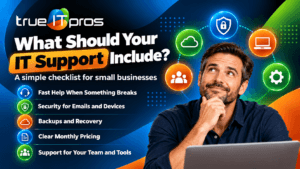
Cybersecurity Support for Small Business: What IT Covers
Cybersecurity support for small business gives owners practical help with protecting email, devices, cloud accounts, and user access. Through managed IT, a company can maintain its security tools, support employees, and respond when something suspicious happens.
Many Atlanta businesses already pay for antivirus software, email filtering, cloud storage, and multifactor authentication. The harder question is who manages those tools, reviews alerts, removes old accounts, installs updates, and makes sure employees know where to report a problem.
A practical Cybersecurity support plan connects tools, people, policies, and response steps. This guide explains what IT support should cover and how small business owners can identify gaps in their current setup.
What does cybersecurity support for small business include?
Cybersecurity support for small business includes the ongoing management of devices, user accounts, email protection, software updates, security tools, backups, monitoring, and incident response planning.
The exact services depend on the company. A five-person consulting firm may have different needs than a construction company with field employees, a veterinary practice with shared workstations, or an accounting firm that handles sensitive financial records.
Most small business security programs should address the following areas:
- User identity and access: Control who can open email, cloud files, business applications, and administrative tools.
- Device protection: Monitor and maintain laptops, desktops, servers, and mobile devices used for work.
- Email security: Reduce phishing, impersonation, malicious attachment, and account takeover risks.
- Software maintenance: Install operating system, browser, application, and security updates.
- Network security: Manage firewalls, wireless networks, remote access, and internet connections.
- Monitoring and alerts: Review system activity and investigate signs of trouble.
- Business continuity: Maintain backups and recovery plans for important systems and files.
- Incident response: Give employees and leaders clear steps to follow after a suspected security event.
Security support can help reduce risk, but it does not guarantee that an attack will never happen. It also does not automatically make a company compliant with every law, contract, or insurance requirement. Those needs should be reviewed based on the company’s data, industry, vendors, and risk profile.
Why are security tools not enough on their own?
Security tools only help when they are configured, updated, monitored, and connected to a clear process. Buying software without assigning someone to manage it can create a false sense of safety.
For example, an Atlanta real estate firm may use multifactor authentication and email filtering. However, the firm may still have former agents with active cloud access, employees using personal laptops, and shared passwords for vendor portals. The tools are present, but important gaps remain.
Common gaps that ongoing IT support can find
- Former employees still have active accounts.
- Too many users have administrator access.
- Security updates are delayed or ignored.
- Personal devices connect to business files without clear rules.
- Email forwarding rules send messages to unknown addresses.
- Backups exist, but nobody has tested the recovery process.
- Employees do not know how to report a suspicious message.
- Security alerts go to an inbox that nobody checks.
Managed IT services for small business provide ownership for these tasks. Instead of assuming each tool is working, the IT provider checks the environment, supports users, and helps company leaders decide what should be improved.
How does managed IT secure user access?
Access management gives each employee the accounts and permissions needed for the job while limiting unnecessary access to sensitive systems and data.
User access changes whenever someone joins the company, changes roles, works with a new vendor, or leaves the business. Without a clear process, permissions can build up over time.
Access management across the employee lifecycle
Onboarding
IT support can create the employee’s email account, apply multifactor authentication, configure the device, install approved software, and provide access to the correct folders and applications. A standard process helps new employees start work without giving them more access than they need.
Role changes
Employees often gain new permissions when they move into a different position. Their old access may remain unless someone reviews it. IT should adjust group memberships, application roles, shared folders, and administrator permissions when responsibilities change.
Offboarding
When an employee or contractor leaves, IT should disable access based on the company’s approved timeline. This may include email, cloud storage, remote access, business applications, phone systems, and company devices. Business files and mailbox data may also need to be transferred to another employee.
What should email security support cover?
Email security support should reduce unwanted messages, protect account access, review suspicious activity, and give employees a fast way to report possible phishing or impersonation.
One compromised mailbox may expose client conversations, invoices, password reset messages, shared files, or access to other cloud tools. This makes email protection both a security issue and a business operations issue.
An IT provider may help manage:
- Spam and phishing filters
- Multifactor authentication
- Login and access policies
- Mailbox forwarding rules
- Shared mailboxes and email groups
- Microsoft 365 or Google Workspace administration
- Email authentication settings such as SPF, DKIM, and DMARC
- Suspicious login and account activity reviews
- Password resets and account recovery
Employees also need a clear reporting process. They should know whether to call the helpdesk, forward the message to a security address, use a reporting button, or contact a manager.
What does endpoint and device security cover?
Endpoint security covers the laptops, desktops, servers, and mobile devices that employees use to reach company systems. These devices need consistent settings and maintenance.
Managed endpoint support may include:
- Device inventory and ownership records
- Operating system and software updates
- Antivirus and malware protection
- Web surfing and DNS protection
- Device health and security monitoring
- Disk encryption when appropriate
- Screen lock and password policies
- Remote support for employees
- Remote lock or wipe options for supported devices
- Removal of unapproved or outdated applications
Device management is especially important for businesses with remote employees, field teams, shared computers, or staff who travel. A construction company may need to protect office workstations and field laptops. A consulting firm may need to support employees working from client locations and home offices.
How does IT support a cybersecurity incident?
IT support helps the business identify the issue, contain affected systems, secure user accounts, restore operations, and document what happened. The response should follow a plan rather than relying on rushed decisions.
- Receive the report: Give employees a known phone number, email address, or helpdesk process for reporting suspicious activity.
- Review the situation: Determine which user, device, account, or application may be affected.
- Contain the issue: Disconnect devices, disable accounts, block messages, or stop access when appropriate.
- Secure access: Reset passwords, revoke active sessions, review multifactor authentication, and remove suspicious forwarding rules.
- Restore operations: Recover files, rebuild devices, or restore systems after the environment is ready.
- Review and improve: Document the cause, business impact, response steps, and changes that may reduce similar risks.
Some incidents may also require help from legal counsel, cyber insurance providers, forensic specialists, law enforcement, or other qualified professionals. The correct response depends on the type of incident and the data involved.
Business owners can also review practical guidance from the Cybersecurity and Infrastructure Security Agency and the NIST Cybersecurity Framework.
Reactive IT support versus proactive security management
Reactive support begins after something breaks or a user reports a problem. Proactive support includes planned maintenance, monitoring, access reviews, and response preparation before a serious issue occurs.
| Security Area | Reactive IT | Proactive Managed IT |
|---|---|---|
| Updates | Installed after a problem appears | Scheduled, monitored, and reviewed |
| User access | Changed when someone remembers | Managed through onboarding, role changes, and offboarding |
| Email protection | Reviewed after phishing reaches users | Filters, authentication, access, and alerts are maintained |
| Monitoring | Limited or not assigned | Infrastructure and alerts are monitored |
| Incident response | Decisions are made during the emergency | Contacts, roles, and first steps are planned |
| Technology planning | Purchases are made when systems fail | Risks, replacements, and budgets are reviewed ahead of time |
How much cybersecurity support does a small business need?
The right level of support depends on the systems the business uses, the information it handles, and the impact of an interruption. A small company does not need to copy the security program of a large enterprise, but it does need clear ownership of its main risks.
Business owners should consider:
- How many employees, contractors, offices, and devices need support?
- Do employees work remotely or from client locations?
- What client, financial, employee, health, or operational data is stored?
- Which systems would stop the company from working if they became unavailable?
- Does the business depend on Microsoft 365, Google Workspace, or industry-specific applications?
- Are there customer contracts, insurance terms, or industry rules that affect security?
- Who reviews alerts and makes decisions during an incident?
- How quickly does the business need technical help?
An architecture firm may focus on large project files, remote access, and software licensing. A law practice may focus on email, confidential documents, and controlled user access. A manufacturer may need to protect office systems while also maintaining reliable networks and production-related technology.
Small business cybersecurity support checklist
Use this checklist to identify areas that may need attention. A “no” or “not sure” answer does not always mean the business has a serious problem, but it does show where a review may be useful.
- Does every employee use an individual account?
- Is multifactor authentication enabled for important cloud services?
- Are former employee accounts disabled through a standard process?
- Are business computers monitored and updated?
- Does someone review email security and suspicious login alerts?
- Can employees quickly report a suspicious email or device problem?
- Are backups protected and tested?
- Does the business know which systems and data are most important?
- Is there a written first-response plan for a security incident?
- Does leadership receive regular guidance about security risks and technology priorities?
When should a small business contact a managed IT provider?
A small business should consider contacting an MSP when security tasks are not clearly assigned, employees wait too long for help, or the company depends on tools that nobody actively maintains.
Common warning signs include:
- Security updates depend on each employee.
- The owner manages passwords, accounts, and devices personally.
- Employees use shared logins.
- Nobody knows whether backups can be restored.
- Former employees still appear in cloud systems.
- The current provider only responds after something breaks.
- The business is adding employees, locations, or cloud applications.
- A customer, vendor, or insurer is asking security questions the company cannot answer.
What can Atlanta businesses expect from trueITpros?
trueITpros helps Atlanta businesses manage everyday IT operations while building a more consistent security foundation. The goal is to connect technical support with the way employees, leaders, and business systems work.
Depending on the business environment, support may include:
- Endpoint management
- Software updates and security patch maintenance
- Antivirus and malware protection
- Web surfing and DNS protection
- Microsoft 365 and Google Workspace administration
- Line-of-business application support
- Cybersecurity breach response support
- Onsite infrastructure and end-user support
- Business continuity services
- Managed networking
- 24/7 IT infrastructure monitoring by a network operations center
- IT policies and procedures
- Customer success management
- Virtual CIO and CTO guidance
Support is available through web chat, email, or phone. trueITpros offers helpdesk response with a 10-minute service-level agreement, availability from 6AM to 6PM EST Monday through Friday, and 24/7 availability when applicable.
Frequently asked questions
What is cybersecurity support for small business?
It is ongoing technical help for protecting devices, accounts, email, networks, cloud tools, and business data. It can also include monitoring, employee support, backups, and incident response planning.
Does managed IT include cybersecurity?
Managed IT often includes security-related services such as patching, endpoint protection, access management, email administration, and monitoring. The exact cybersecurity services should be confirmed with the provider.
Can a small business manage cybersecurity without an internal IT team?
Yes. Many businesses use an MSP to provide day-to-day support, security maintenance, monitoring, and planning. Company leaders should still take part in decisions about risk, policies, insurance, and business priorities.
How can managed IT services help prevent phishing?
Managed IT can maintain email filters, secure user accounts, review suspicious activity, support multifactor authentication, and help employees report phishing attempts. No single tool can block every unwanted message.
What should I ask a small business cybersecurity provider?
Ask who monitors alerts, how quickly users receive help, what tools are included, how accounts are managed, how backups are tested, and what happens during a suspected breach.
Build a security support plan your team can use
Effective security support is not limited to installing antivirus software. It requires clear account controls, maintained devices, protected email, tested recovery options, responsive user support, and a plan for handling suspicious activity.
To learn more about how trueITpros can help your business with cybersecurity support for small business, contact us.
To learn more about how trueITpros can help your company with Managed IT Services in Atlanta, contact us at www.trueitpros.com/contact
Related Content
- Why Email Security Matters for Atlanta SMBs
- What is a Managed IT Service Provider (MSP) & How Can It Help Your Business?
“`